AI safety boundaries | Published August 5, 2026
When a Recall Question Reaches the Assistant: The Safe-Answer Boundary
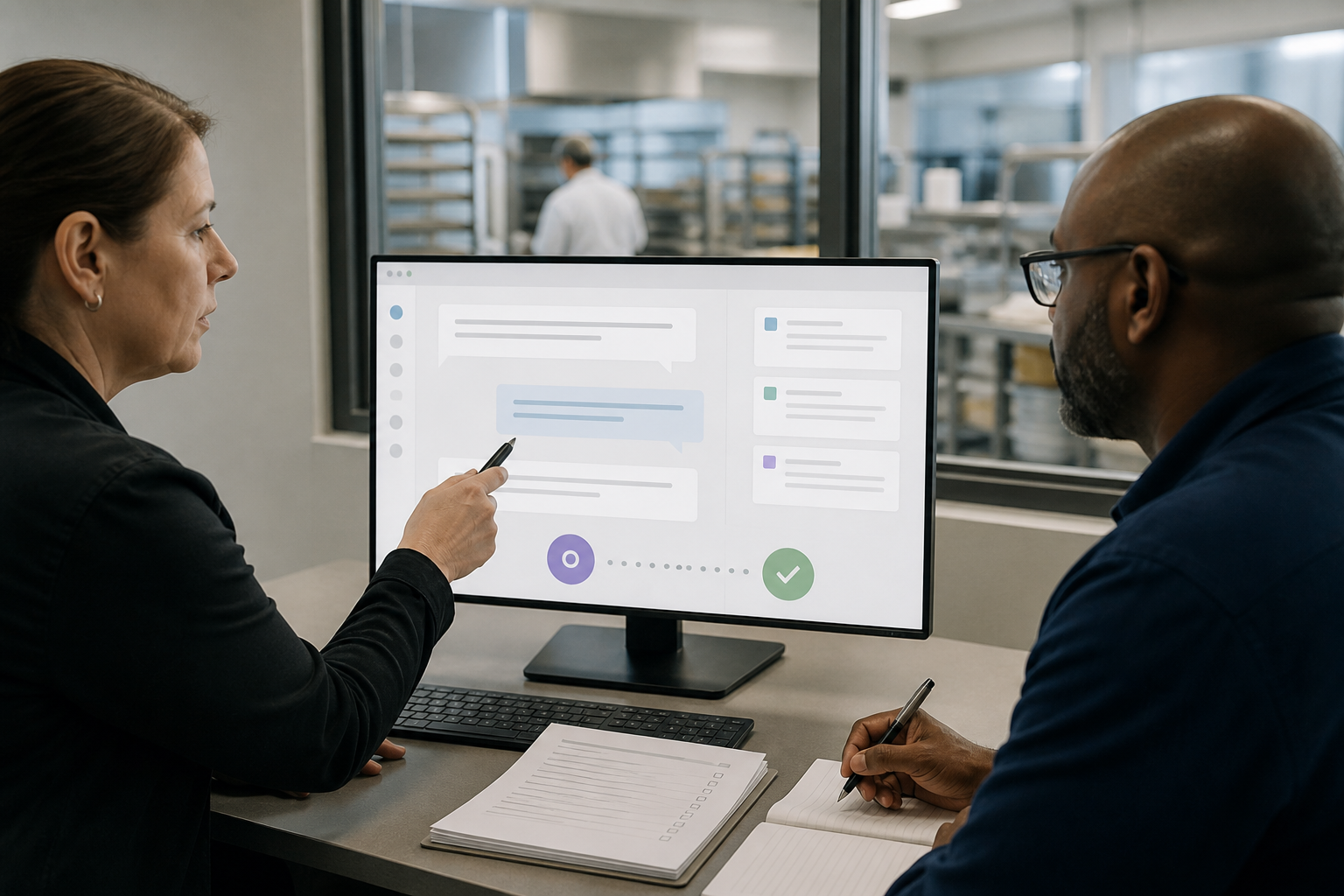
A food-recall question can affect what is served, removed, communicated, or escalated. An assistant should not answer from general memory when the controlling facts depend on a current notice, exact product identifier, lot, location, and operational context.
The FDA recall index carried several current July food notices. NIST's July AI security workshop highlighted access control, data storage, and agentic workflows. The FTC AI accuracy notice provides broader background on reasonable accuracy expectations. Together they support a conservative rule: current, consequential answers need current evidence and bounded authority.
Keep approved knowledge and incident ownership connected through the ServingIntel Genesis platform.
Separate information from action
- May explain: what a recall is and where official notices are found.
- May summarize with citation: the current notice's verified public scope.
- Must escalate: whether a local product, resident, guest, or meal is affected.
- Must not do: release a hold, approve a substitute, diagnose illness, or invent missing identifiers.
The POS University allergen stop test gives the human dining team a companion operational workflow.
Require a current-source bundle
- Identify the issuing authority and exact notice URL.
- Capture publication and last-update timestamps.
- Extract product, lot, date, geography, and required action.
- Check for a newer correction, expansion, or closure.
- Cite the controlling source in the answer.
Keep source access, ownership, and withdrawal controls documented through ServingIntel support resources.
Label what the data cannot prove
A receipt, recipe, or order record can narrow the question without proving exposure. The ServingIQ three-table recall query classifies evidence as confirmed, possible, ruled out, or unknown. The assistant should preserve those labels and never convert “possible” into “affected.”
Review endpoint and fallback assumptions through ServingIntel hardware planning.
Test the human handoff
Run scenarios with a missing lot code, an outdated notice, conflicting supplier wording, an unavailable source, and a question about symptoms. Verify that the assistant stops at the boundary, cites what it knows, names what is missing, and routes the case to the approved owner.
Monitor current operational changes through ServingIntel News & Insights. Withdraw or supersede the assistant's source as soon as the controlling notice changes.
The bottom line: a safe assistant can accelerate source retrieval and structured handoff, but it should never turn an incomplete recall question into an operational decision.